
Recapturing a Medieval Mind

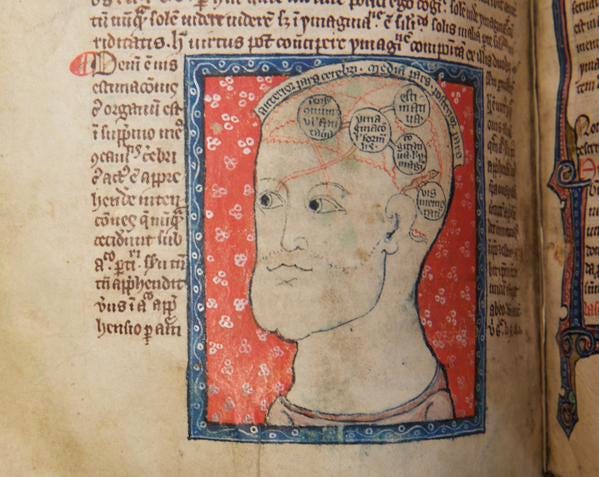
This is by a couple of friends - Father Brian Foos and John Seel, Ph.D.
It was first published in The North American Anglican.
The full article is available here. What follows is a taste:
The world of classical education is fond of C. S. Lewis. And rightly so. Without using the term “classical education,” his Abolition of Man clearly shows the hollowness at the core of modern, progressive schools; classical Christian educators have been providing a better alternative for many decades. His winsome and creative children’s stories are included in classical Christian school curriculum far and wide. His apologetic and literary works are accessible to high school students and trained scholars alike. What may be less understood in the world of classical education is that, while Lewis himself possessed great native intelligence, his influence without a doubt would be far less had he not been immersed in a disciplined study of that synthesis of the classical and the Christian which we now call “medieval.”
Lewis himself said that he was a “medieval man.” In 1954, in his inaugural address De Descriptione Temporum, at Cambridge as the chair of Medieval and Renaissance English, he described himself as a native of the medieval era. This is a mature, seasoned reflection on his educational calling. He said, “I read as a native, texts you must read as foreigners.” He continues: “…Where I fail as a critic, I may yet be useful as a specimen. I would even dare to go further. Speaking not only for myself but for all other Old Western men whom you may meet, I would say, use your specimens while you can. There are not going to be many more dinosaurs.”
The question before Anglican educators is: Are we cultivating medieval students—dinosaurs, in Lewis’ terminology? And why do we want to? If we aim to help our students be counter-cultural adults, to engage, live, and thrive for the Kingdom in the culture of advanced modernity, into what positive world are we then enculturating them? A Christianized advanced modernity with a patina of Plato will not do. C. S. Lewis, for one, was medieval to the core. But what do we mean by “medieval”?
One of Lewis’ main points in De Descriptione Temporum is that the greatest divide in history is not between the Dark Ages and Renaissance. “If we do not put the Great Divide between the Middle Ages and the Renaissance, where should we put it?” he asks. In the rest of the address, Lewis makes a strong argument that the dividing line—what he came “…to regard as the greatest of all divisions in the history of the West [is] that which divides the present from, say, the age of Jane Austen.” The great divide is between the pre-modern and modernity.
Modernity is the biggest change and challenge in the history of Western Civilization. And now modernity itself has run its course, so that we are living amid a historic inflection point, a “hinge moment,” from the collapse of modernity to who-knows-what. Whatever the near future holds, and it is impossible to predict, the Church must prepare and equip the next generation to face this unknown with a greater resilience and discernment than is typical of our efforts. Casual, half-hearted approaches will not do in such a time of historic import. Now is the opportune moment to return to the long-abandoned pre-modern mind, in the form of the medieval synthesis of the classical and Christian. This mindset was abandoned not because it was untrue or ineffective. It was abandoned because it was inconvenient to an increasingly man-centric view of reality.
To be equipped for a post-postmodern world, we must return to a pre-modern mindset. That sounds very strange to the average American. “Why would I want to be so ignorant and uneducated as a medieval person?” we can hear the critics say. “The Dark Ages were dark, after all.” We may have heard the phrase “positively medieval” used to denigrate someone or something. But actually, this mindset is backward. Ours is the dark ages, the age of disenchantment, the deathwork. As philosopher Peter Kreeft writes, “We are now living in the real Dark Ages, which history books of the future will describe as ‘The Century of Genocide.’”
In addition to the “great divide” Lewis wrote of, he also points out two great spiritual revolutions in Western civilization: the first was from pre-Christian to Christian, but the second is from Christian to post-Christian—and is happening now. Furthermore, Lewis observed, “It appears to me that the second change is even more radical than the first (as divorce is more traumatic than marriage).” Lewis rightly said that the pagan and Christian have more in common than each has with the post-Christian. With the collapse of modernity, evidenced by the shift to the post-Christian, what is needed is a shift back to the variety of Christianity untainted as far as possible by the Enlightenment or modernity—a form completely different from what Kreeft describes as “accommodation to modernism, egalitarianism, niceness, naturalism, pop psychology, secular humanism, relativism, subjectivism, individualism, “Enlightenment” rationalism or postmodern irrationalism.” And this alternate variety, the synthesis of the classical and the Christian, is what we might call “positively medieval.”
. . . see link above for the complete article